
1. Why Material Quality Matters in Banquet Decor
Professional Flower Ball Service Quality is no longer determined by appearance alone. In the 2026 U.S. wedding and event market, professional buyers increasingly evaluate artificial floral products through realism, texture, color depth, structural stability, photography performance, durability, and long-term value.
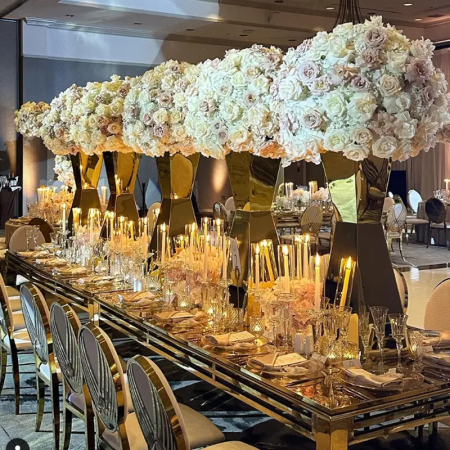
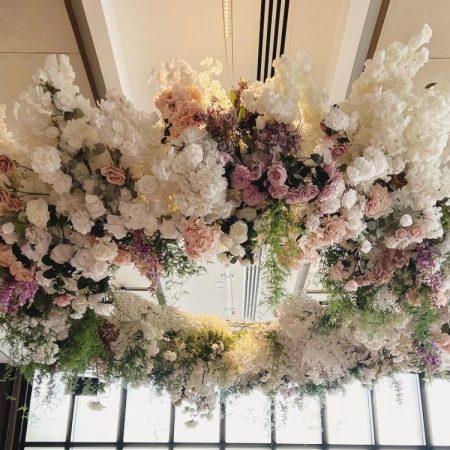
This is especially important for flower balls because they are often placed in highly visible locations. They may hang above banquet tables, decorate wedding entrances, frame reception backdrops, sit on pedestals, or become part of large-scale ceiling installations.
Current wedding décor is increasingly layered, immersive, and visually dramatic. The Knot’s 2026 wedding décor coverage highlights layered tablescapes, opulent details, sculptural elements, and statement decoration.
Under professional lighting and photography, material weaknesses become much easier to notice.
For commercial buyers, the question should therefore not be simply, “Which flower ball is cheaper?”
The better question is:
Which material can deliver the required appearance, durability, and consistency throughout the entire event lifecycle?
2. Micro-Fiber Materials vs Low-Grade Plastics
When evaluating Professional Flower Ball Service Quality, material selection should be one of the first considerations.
Micro-fiber and fine fabric-based petals can create a softer visual surface because they tend to diffuse light rather than reflect it like hard, glossy plastic. Well-made fabric petals can also be shaped and layered to create more natural-looking depth.
Low-grade plastic has a very different visual character. It is often rigid, excessively glossy, highly uniform, and less capable of reproducing the subtle texture found in natural petals.
This difference becomes particularly obvious under banquet spotlights or camera flashes.
However, buyers should not assume that every plastic material is low quality. Higher-grade molded polymers can work well for certain flowers, foliage, berries, orchids, succulents, and specialized outdoor applications.
The real concern is low-grade plastic used as a cost-saving substitute for premium floral construction.
Professional buyers should compare:
- Surface finish: matte or softly textured surfaces generally create a more natural appearance.
- Petal flexibility: quality petals should allow controlled shaping without cracking.
- Color variation: realistic flowers usually have depth rather than one flat color.
- Edge finishing: clean edges reduce the inexpensive craft-product appearance.
- Structural support: frames, wires, stems, and attachment points should withstand installation.
- Weight distribution: large flower balls should remain balanced after hanging.
3. How Material Choice Changes the Guest Experience
Professional Flower Ball Service Quality becomes particularly important when guests are close to the decoration.
From several meters away, a low-cost plastic flower may look acceptable. At a banquet table, entrance, sweetheart table, or photography area, the same product can reveal its weaknesses.
Texture is one of the main reasons.
Fine fabric or micro-fiber surfaces can create subtle shadows between petals. These shadows add depth and help the eye interpret the flower as a more natural object.
Hard plastic often produces stronger highlights. Under direct lighting, these reflections can flatten the visual effect and make the flower look noticeably synthetic.
Photography creates another challenge.
Professional cameras capture details that may not be obvious to the naked eye. Excessive shine can become distracting in wedding photographs, while overly uniform colors may look artificial when photographed from close range.
For U.S. wedding planners and event designers, this matters because floral decoration is now part of the event’s visual content. Guests photograph reception tables, backdrops, entrances, hanging installations, and decorative details throughout the celebration.
A flower ball that looks acceptable from a distance may therefore fail when it becomes the subject of a close-up photograph.
4. The Yongnuo Approach to Professional Flower Ball Service Quality
Yongnuo Flower approaches artificial flower production from the perspective of commercial event use rather than simple decorative appearance.
For professional buyers, the goal is to create products that remain visually consistent across sampling, bulk production, installation, photography, packaging, and repeat orders.
Yongnuo’s trade information states that its business works with direct factories and supports ODM/OEM customization, including flower types, colors, sizes, and packaging.
For international buyers, this flexibility can be valuable when a wedding concept requires a specific color palette, flower combination, size, or packaging format.
A professional manufacturing process should consider:
- petal material and thickness
- color consistency
- flower-head density
- internal frame strength
- attachment security
- finished diameter
- finished weight
- packaging compression
- shape recovery after unpacking
- installation requirements
- repeat-order consistency
The important point is that material selection should be connected to the final application.
A hanging flower ball designed for a luxury ballroom may require different construction priorities from a small centerpiece intended for retail packaging.
5. Why Low-Grade Plastic Can Increase the Real Cost
A lower unit price does not automatically mean a lower project cost.
Suppose a buyer chooses inexpensive flower balls for a premium banquet installation. If the material appears too glossy or artificial, additional styling, foliage, lighting adjustments, replacement pieces, or upgraded accessories may be required to compensate.
Handling can create additional problems.
Brittle petals may crack during transportation or installation. Weak attachment points can separate when the product is moved. Poor packaging can also cause deformation that requires significant reshaping before an event.
Therefore, Professional Flower Ball Service Quality should be evaluated according to total cost rather than purchase price alone.
A useful commercial model is:
Total Cost = Material + Packaging + Shipping + Labor + Installation Risk + Replacement Risk − Reuse Value
For rental companies and professional decorators, this distinction is particularly important.
A slightly more expensive flower ball can become the more economical product if it survives multiple events, photographs better, requires less corrective styling, and maintains its appearance across repeated installations.
6. Quality Testing Before a Bulk Order
Before approving a large production run, buyers should test flower balls under realistic banquet conditions.
First, inspect the product under daylight and warm artificial lighting. Photograph it from several distances and angles. Check whether the petals create excessive glare and whether the colors remain balanced.
Next, perform a handling test.
Open the package, reshape the product, hang it, rotate it, and move it several times. Look for:
- loose petals
- weak joints
- exposed wire
- deformation
- unstable weight distribution
- poor shape recovery
Professional Flower Ball Service Quality should also be evaluated through production consistency.
One perfect sample is not enough.
A commercial buyer should ask how the manufacturer compares bulk production against the approved sample and how material, color, size, packaging, and construction are controlled.
Before ordering, request:
- approved pre-production sample
- exact dimensions
- material information
- product weight
- packaging specifications
- carton quantity
- production lead time
- inspection procedure
- replacement policy
- bulk-production photographs or videos when appropriate
7. Which Material Is Better for Different Banquet Applications?
There is no single material that is ideal for every flower ball.
Micro-fiber or fine fabric materials are particularly useful when the priority is soft texture, layered petals, realistic color, lightweight construction, and close-range visual quality.
Higher-grade molded materials can be appropriate when a specific botanical form requires greater structural stability or a smooth real-touch effect.
Low-grade plastic may still have a role in temporary, low-visibility, budget-focused decoration. However, it is generally a weaker option when the flower ball is a major focal point.
Professional Flower Ball Service Quality should therefore be matched to viewing distance, event positioning, lighting, and expected reuse.
A practical application strategy is:
| Banquet Application | Recommended Material Direction |
|---|---|
| Luxury wedding centerpiece | Premium fabric or mixed premium materials |
| Hanging ballroom installation | Lightweight, stable, visually soft materials |
| Photo backdrop | High-realism petals with color variation |
| Rental inventory | Durable construction and strong shape recovery |
| Outdoor event | Application-specific weather-resistant materials |
| Temporary budget décor | Lower-cost materials where close inspection is limited |
8. How U.S. Buyers Should Compare Suppliers
American buyers should avoid evaluating suppliers only through catalog photographs.
Ask for close-up material photographs, videos under different lighting, product dimensions, packaging information, and physical samples.
If the products will be reused, ask how the manufacturer maintains quality consistency between production batches.
Professional Flower Ball Service Quality is also connected to communication.
A supplier that understands the venue, installation method, viewing distance, color palette, quantity, and event schedule can recommend a more appropriate construction approach.
For U.S. wedding planners, event rental companies, decorators, wholesalers, and hospitality buyers, the ideal supplier is not necessarily the manufacturer offering the lowest quotation.
The stronger supplier is the one capable of reproducing the approved design at commercial scale while maintaining quality, packaging reliability, customization capability, and delivery consistency.
9. A Practical Supplier Evaluation Checklist
Before placing an order, evaluate the supplier in five areas:
1. Material Realism
Does the surface look natural under different lighting conditions?
2. Construction
Are petals, stems, frames, and attachment points secure?
3. Consistency
Can the manufacturer reproduce the approved sample?
4. Logistics
Is the packaging designed to protect the product during international transportation?
5. Customization
Can the supplier adjust colors, sizes, flower varieties, packaging, and quantities?
Professional Flower Ball Service Quality should be judged across all five categories.
A manufacturer that performs strongly in only one area may still create problems later in the project.
10. The Long-Term Value of Better Flower Balls
The strongest reason to choose better materials is not simply that they look more expensive.
Professional event decoration needs to perform repeatedly.
A wedding rental company may use the same flower balls across dozens of events. A hotel may keep floral installations in rotation. A planner may reuse a coordinated collection for weddings, corporate events, bridal showers, and photo shoots.
In these situations, durability and appearance become business assets.
Professional Flower Ball Service Quality can influence customer satisfaction, photography quality, rental lifespan, replacement frequency, and the perceived value of the overall event design.
Buyers should therefore think beyond the first event.
The right flower ball is not simply a decorative object. It can become part of a rental inventory, design system, and long-term customer experience.
FAQ
Q1: What is the most important factor in Professional Flower Ball Service Quality?
Material realism and construction quality are two of the most important factors. Buyers should evaluate surface texture, color depth, structural stability, and production consistency rather than price alone.
Q2: Are micro-fiber flower balls better than plastic flower balls?
Not automatically. High-quality polymers can perform well in specific applications. However, fine fabric or micro-fiber materials often provide a softer visual effect than low-grade glossy plastic.
Q3: How can I test flower balls before a bulk order?
Request a physical sample, inspect it under multiple lighting conditions, photograph it, reshape it, hang it, and examine the attachment points. Then confirm that the manufacturer can reproduce the approved sample during mass production.
Q4: Are low-grade plastic flower balls suitable for weddings?
They can work for low-visibility or short-term applications, but they are usually a weaker choice for premium focal areas where guests and cameras are close to the décor.
Q5: What should U.S. buyers ask a Chinese flower ball manufacturer?
Ask about materials, dimensions, weight, customization, sample approval, production lead time, packaging, quality inspection, replacement handling, and repeat-order consistency.
Conclusion
Professional Flower Ball Service Quality is ultimately about matching material selection and manufacturing standards to the real demands of banquet decoration.
Micro-fiber and premium fabric materials can provide softer texture, better light diffusion, and stronger close-range realism. Carefully selected molded materials can provide structural advantages for specific flower varieties. Low-grade plastic may reduce the initial purchase price, but it can create hidden costs through weaker appearance, lower durability, and limited reuse value.
For U.S. wedding planners, decorators, rental companies, wholesalers, and hospitality buyers, the best sourcing strategy is to compare the complete product—not simply the quotation.
When material quality, construction, consistency, packaging, customization, and long-term reuse are evaluated together, flower balls become more than decoration.
They become reliable components of a professional event-design system.