


The global floral decoration market has experienced a significant transition over the past two decades, with synthetic alternatives capturing substantial market share due to their longevity, cost-effectiveness, and versatile design options. Within this competitive landscape, Henan Yongnuo Trading Co., Ltd. has established a significant presence. As a Global Leading Artificial Floral Arrangements Exporter, the enterprise has engineered a comprehensive ecosystem combining large-scale manufacture, rigorous quality controls, and localized international logistics. Modern commercial floral setups require materials that maintain structural integrity under various environmental conditions, including indoor heating, transportation stress, and prolonged storage. Premium artificial floral elements fulfill these requirements by utilizing advanced polymers and specialized textiles that prevent degradation while closely replicating the visual nuances of natural flora. By addressing the practical and aesthetic challenges faced by commercial planners, event designers, and retail consumers, Yongnuo has transitioned from a localized production factory into an international enterprise, establishing itself as a trusted supplier across major global retail platforms including Amazon.
Analysis 1: Industrial Scale and Production Infrastructure
A primary factor supporting the enterprise’s market position is its large-scale production infrastructure, which addresses a common bottleneck in the international floral supply chain: the balance between rapid order fulfillment and batch consistency. Operating from a 30,000-square-meter modern manufacturing facility equipped with 20 automated and semi-automated production lines, the company maintains stable capacity controls capable of scaling output based on seasonal global demand.
In foreign trade and cross-border e-commerce, fulfillment delays often cause immediate financial losses for seasonal event planners or retail sellers managing tight inventory cycles. The establishment of dedicated production lines allows for structured project scheduling and reduced lead times. Raw material processing, fabric shaping, polymer injection, and final structural assembly are organized sequentially within a single facility. This continuous operational model minimizes internal handling delays and provides a clear timeline from raw material input to container loading, ensuring predictable delivery schedules for international partners.
Analysis 2: Quality Control Systems and Return Mitigation
In cross-border e-commerce, particularly for bulk high-volume items sold on platforms like Amazon, product returns represent a major risk to operational profitability. High return rates inflate reverse logistics costs and damage seller performance metrics. To mitigate these risks,the company utilizes an integrated quality control system that monitors the production process from raw material inspection through final packaging.
By identifying and correcting structural or visual deviations before items leave the factory floor, the enterprise minimizes standard manufacturing defects such as petal detachment, unstable framework connections, or uneven coloration. This preventive approach reduces post-purchase dissatisfaction and lowers return metrics for distribution partners. Maintaining low defect rates protects seller account health on retail platforms and ensures that commercial buyers receive event-ready products that do not require unexpected onsite adjustments or replacements.
Analysis 3: Material Integration, Technical Architecture, and Product Adaptation
The durability and visual appeal of modern synthetic botanical products depend heavily on material science and structural engineering. The company utilizes a dual-material approach, selecting specific mediums based on the mechanical and aesthetic requirements of the final product.
Polyester Silk Fabrics: Primarily used for delicate floral components like roses, peonies, and hydrangeas. The woven polyester substrate undergoes specialized thermal pressing to introduce lifelike texturing, deep veining, and structural curvature. Silk fabric holds color gradients effectively, allowing for realistic pigment applications that resist fading under standard indoor lighting.
Polyethylene (PE) Foam: Utilized for high-density arrangements, foundational structural layers, or moisture-resistant outdoor components. PE foam provides substantial structural resilience, allowing petals to retain their shape after being compressed in shipping containers. The material is lightweight and flexible, which facilitates clean cutouts and strong mechanical anchoring during manual assembly.
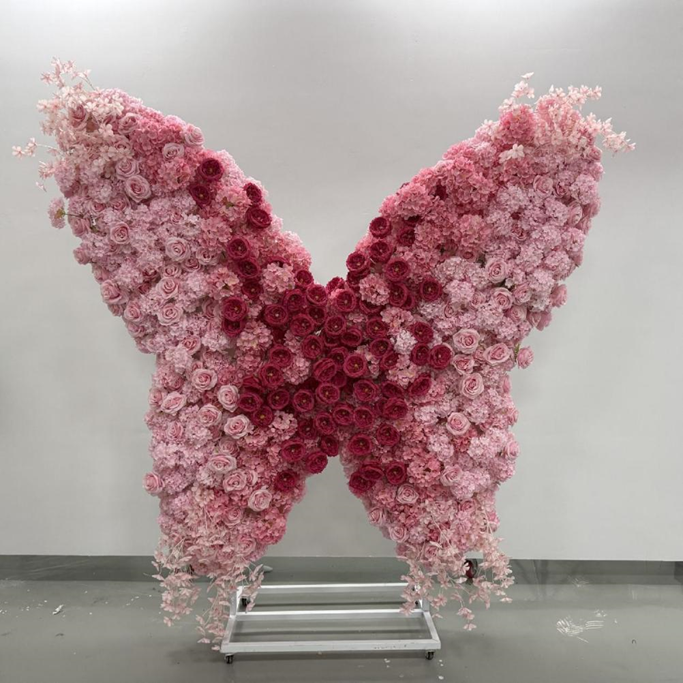
The integration of these materials is clearly demonstrated in large-scale installations, such as the 1.8-meter giant pink handmade rose artificial flower wall stand. Designed as a modular backdrop for weddings, banquets, commercial exhibitions, and holiday celebrations, this product features a heavy-duty fabric or grid backing that supports thousands of individually anchored silk and PE blossoms. The structural architecture allows the large panel to be rolled, packed, transported, and re-erected without losing structural integrity or shedding components. The flower wall’s performance parameters include high tear resistance, structural stability under vertical hanging tension, and uniform depth configuration across the full 1.8-meter span, ensuring a consistent visual presentation across different lighting setups.
Analysis 4: Application-Driven Design and Contextual Customization
The modern synthetic floral market requires flexible product designs that can adapt to different commercial environments. The company’s catalog is structured around key application areas, allowing it to serve multiple market segments simultaneously.
Wedding and Event Production: Large-scale backdrops, tabletop runners, aisle borders, and bridal arrangements must withstand fast setup and teardown cycles. High-quality synthetic pieces offer a distinct advantage over natural cut flowers by eliminating water requirements, preventing wilting under staging lights, and allowing event companies to reuse inventory across multiple event dates.
Commercial and Home Decoration: Retail storefronts, corporate lobbies, hotels, and residential spaces utilize artificial botanicals for long-term interior decoration. These settings require products that need minimal maintenance, resist dust accumulation, and do not emit volatile compounds or allergens, making them suitable for public environments.
To address specific event requirements, the manufacturer offers custom services that let buyers modify structural sizing, color palettes, and specific botanical combinations. This flexibility is supported by an agile manufacturing system that can adjust production lines for custom short-run orders without causing major downtime. This capability enables corporate buyers to align floral installations with specific brand guidelines or custom event themes.
Analysis 5: Supply Chain Integration, Logistics, and E-Commerce Optimization
Sustaining a high-volume supply presence on global platforms like Amazon requires more than just manufacturing capabilities; it demands an optimized international logistics network. The company addresses long-distance supply challenges through an integrated global delivery model that balances bulk maritime transport with rapid domestic fulfillment. Standard international shipments utilize maritime freight options with average transit times of 30 to 40 days, allowing commercial buyers to optimize bulk ordering costs for predictable inventory cycles. For urgent project demands or rapid inventory replenishment, the company coordinates with international express couriers to provide expedited shipping windows of 10 to 15 days. By maintaining high baseline inventory levels of popular structural items—such as modular flower walls and standard white or pink rose panels—the enterprise can fulfill orders quickly, helping e-commerce partners avoid out-of-stock penalties and maintain stable sales rankings on competitive digital marketplaces.
This supply chain model is supported by a 24/7 customer service framework designed to handle the fast-paced requirements of international B2B procurement and e-commerce logistics. Dedicated service teams provide rapid responses to technical specifications, order status updates, and customs documentation requests across different time zones. Providing continuous operational visibility reduces transactional friction, helps international buyers manage predictable inventory levels, and confirms the company’s position as a reliable supplier in the global artificial floral market.
Corporate Website: https://www.yongnuoflower.com/

