

1. Why 3D Flower Walls Are Changing Modern Event Design
A China Leading Flower Wall Company today needs to solve a much more complex problem than simply attaching artificial flowers to a backing panel.
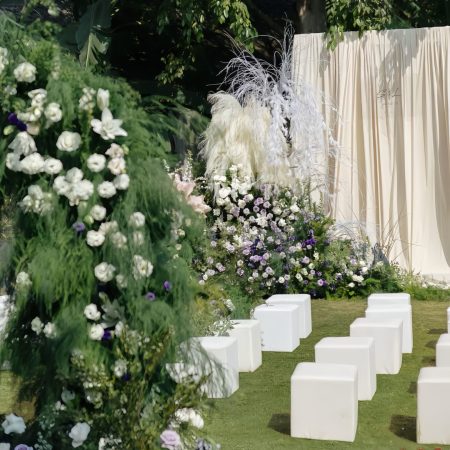
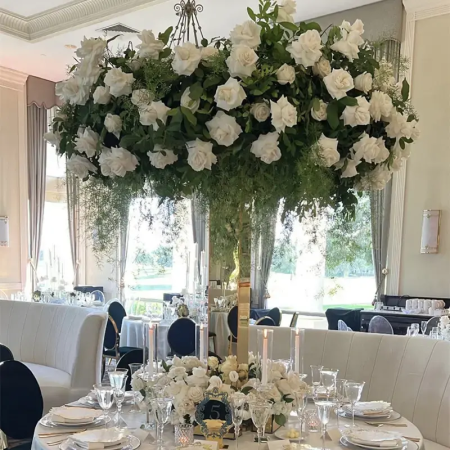
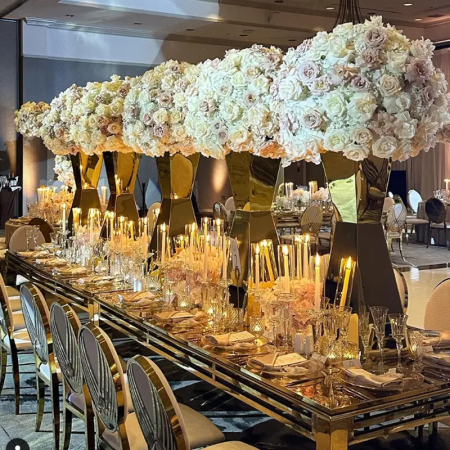
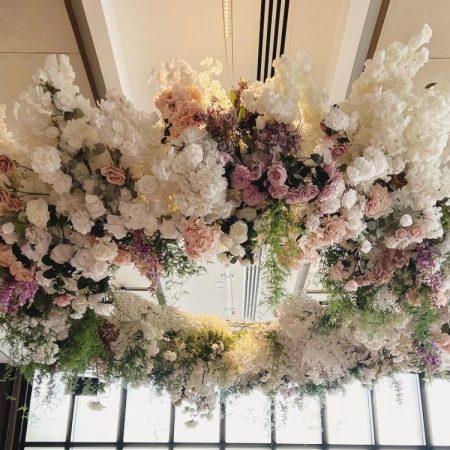
In 2026, floral installations are increasingly being treated as architectural and experiential elements. Wedding designers are using dramatic backdrops, sculptural arrangements, layered textures, and immersive floral installations to shape how an entire venue looks and feels. The Los Angeles Times’ 2026 wedding-trend coverage describes this shift toward expressive, tactile, art-oriented floral design, while current flower-wall industry coverage highlights three-dimensional textures and varied floral depths.
This creates a new manufacturing challenge.
A large flower wall must look like one continuous botanical landscape even though it may actually consist of multiple modular sections.
If the modules are visually disconnected, the illusion immediately breaks.
Visible grid lines, uneven flower density, repetitive patterns, or flat surfaces can make an otherwise expensive installation look like a collection of inexpensive rental panels.
The goal of advanced manufacturing is therefore clear:
Create modular products that assemble into one visually continuous three-dimensional floral environment.
2. What Defines a China Leading Flower Wall Company?
A China Leading Flower Wall Company should be evaluated according to more than the number of flower styles it produces.
Professional buyers should examine whether the manufacturer can control the complete relationship between:
- flower selection
- material quality
- flower density
- panel structure
- dimensional consistency
- three-dimensional depth
- connection systems
- packaging
- installation requirements
- quality control
This is particularly important for large commercial projects.
A small floral panel can hide minor inconsistencies.
A 20- or 30-square-meter backdrop cannot.
As the installation becomes larger, every manufacturing inconsistency becomes more visible.
This is why modern flower-wall production is increasingly becoming an engineering problem as well as a floral-design problem.
3. The Engineering Challenge Behind a Seamless Backdrop
The biggest problem with modular flower walls is the seam.
Large floral backdrops need to be divided into manageable sections for production, transportation, storage, and installation.
However, placing multiple standard panels side by side can create:
- vertical gaps
- visible grid lines
- compressed flowers
- inconsistent density
- uneven panel alignment
- structural sagging
- repetitive flower patterns
A recently published Yongnuo technical article specifically identifies these issues as major obstacles to achieving continuous visual quality in large artificial floral installations. It describes approaches involving redesigned backing grids, varied flower placement, three-dimensional layering, interlocking fasteners, and stricter quality control.
The challenge is therefore not simply making each panel attractive.
It is making the connection between panels visually disappear.
4. The Yongnuo Flower Approach to 3D Floral Engineering
Yongnuo Flower approaches custom artificial floral production from both a decorative and manufacturing perspective.
For a large flower wall, the finished product needs to be considered as an integrated system rather than a collection of individual flowers.
The manufacturing process can involve decisions about:
- backing-grid structure
- flower-head size
- flower density
- stem length
- attachment angle
- foliage distribution
- panel dimensions
- connection points
- finished depth
- packaging method
This approach is particularly important for 3D installations.
A flat panel can rely heavily on uniform flower placement.
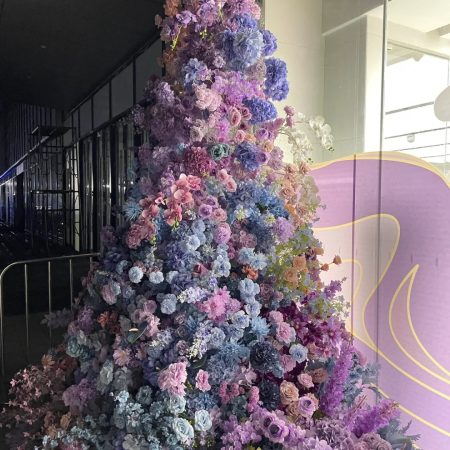
A three-dimensional backdrop requires deliberate variation in depth.
Some flowers should sit close to the structural surface.
Others should project forward.
Larger focal blooms can occupy the highest visual layer, while foliage and smaller flowers help fill the lower structural levels.
This creates a more convincing sense of depth.
5. Three-Dimensional Layering Creates Visual Realism
For a China Leading Flower Wall Company, three-dimensional layering is one of the most important areas of innovation.
A flat artificial wall often looks artificial because every flower occupies approximately the same depth.
Natural botanical environments do not behave that way.
Flowers, leaves, stems, and branches exist at different distances from the viewer.
Advanced flower-wall construction attempts to reproduce this visual hierarchy.
Layer One: Structural Base
The first layer provides the foundation and helps conceal the underlying support structure.
Layer Two: Secondary Flowers and Foliage
Smaller flowers and greenery create intermediate depth and fill visual gaps.
Layer Three: Statement Blooms
Larger flowers are positioned farther forward to create focal points and stronger shadows.
Layer Four: Edge Integration
Flowers near the panel perimeter extend visually beyond the physical boundary.
This final layer is particularly important because it helps neighboring modules blend together.
The result is a wall that appears to have continuous botanical growth rather than separate rectangular sections.
6. Flower Density Determines Whether Seams Remain Visible
A China Leading Flower Wall Company must carefully balance flower density.
Too little material exposes the backing structure.
Too much material can increase:
- product weight
- material cost
- shipping cost
- installation complexity
- storage requirements
The objective is therefore not simply maximum density.
The objective is strategic density.
High-density areas should be used where structural elements or panel connections need to be concealed.
More open areas can be used where foliage and depth already create sufficient visual coverage.
This approach also improves the visual rhythm of the finished backdrop.
Instead of creating an undifferentiated mass of flowers, the manufacturer can guide the viewer’s eye through different layers of color, texture, and depth.
For professional buyers, this distinction can have a significant effect on the perceived value of the finished installation.
7. Hidden Connections Are Essential to Seamless Assembly
A China Leading Flower Wall Company must solve the mechanical problem behind the visual illusion.
Traditional cable ties or basic connectors may hold panels together, but they do not necessarily create consistent alignment.
If one connection is tighter than another, neighboring panels may sit at different angles.
That can create shadows and gaps that become visible under strong event lighting.
More advanced modular systems can use standardized connection points designed to maintain consistent alignment.
The Yongnuo technical material describes integrated interlocking fasteners intended to improve horizontal and vertical alignment and reduce visible separation between modules.
For commercial buyers, the important principle is simple:
The connection system should support the visual design rather than interrupt it.
8. Why 3D Flower Walls Photograph Better
A China Leading Flower Wall Company should also design for photography.
Flower walls frequently become the background for:
- wedding portraits
- couple photographs
- guest photographs
- photo booths
- social-media content
- brand activations
- corporate events
Flat surfaces tend to produce limited shadow variation.
Three-dimensional surfaces create more visual depth.
When directional lighting hits flowers positioned at different depths, the installation produces highlights, shadows, and tonal variation.
This can make the backdrop appear richer in photographs.
The 2026 wedding market’s movement toward immersive and sculptural floral design reinforces the importance of this effect. Floral installations are increasingly being treated as major visual elements that shape the atmosphere of the venue rather than simply decorative accessories.
For rental companies and event planners, this can make a well-designed 3D wall particularly useful as a repeatable photographic focal point.
9. Modular Design Solves the Logistics Problem
A China Leading Flower Wall Company must balance visual scale with transportation practicality.
A huge one-piece floral wall may look impressive in a showroom, but it can be difficult and expensive to manufacture, ship, move through doorways, store, and install.
Modular construction solves many of these problems.
Instead of shipping one enormous structure, manufacturers can produce smaller sections that are assembled at the destination.
This provides several commercial advantages:
- easier international shipping
- easier warehouse storage
- simpler handling
- easier installation
- easier replacement
- greater design flexibility
- more efficient reuse
The important challenge is maintaining visual continuity after assembly.
Modularity should improve logistics without making the final installation look modular.
10. Quality Control Must Begin Before Final Assembly
For a China Leading Flower Wall Company, quality control cannot be limited to checking the completed wall.
The manufacturing process should monitor individual components before they become part of the final installation.
Important checkpoints include:
| Quality Area | What Should Be Controlled |
|---|---|
| Flower color | Consistent with approved sample |
| Flower size | Consistent within defined tolerance |
| Material | Correct specification |
| Stem attachment | Secure |
| Flower density | Controlled |
| Panel dimensions | Consistent |
| Connector position | Accurate |
| Surface depth | Matches approved design |
| Packaging | Prevents crushing |
| Final assembly | Seam and alignment inspection |
The Yongnuo technical publication also emphasizes color-matching checks, attachment strength, and batch consistency because small variations can become highly visible across large floral installations.
This is an important distinction between handcrafted appearance and uncontrolled production.
A professional manufacturer needs to preserve the handcrafted visual effect while maintaining industrial consistency.
11. Customization Turns Flower Walls Into Design Systems
For a China Leading Flower Wall Company, customization is one of the strongest ways to create value for professional buyers.
A standard flower wall may provide one fixed color combination.
A custom system can be designed around the buyer’s project.
Possible customization includes:
- flower varieties
- color gradients
- monochromatic palettes
- foliage ratios
- panel dimensions
- overall backdrop shape
- flower density
- three-dimensional depth
- logo areas
- signage integration
- modular configuration
This is especially useful for luxury wedding planners, hotels, event rental companies, retail displays, and corporate brand activations.
The goal is not merely to sell a flower wall.
It is to create a reusable visual system that can be adapted to different event environments.
12. How U.S. Buyers Should Evaluate a 3D Flower Wall Manufacturer
Before placing a bulk order, buyers should request more than catalog photographs.
A practical evaluation should include:
1. Physical Sample
Inspect the actual flowers, materials, structure, and depth.
2. Panel-to-Panel Test
Connect several panels together and inspect the seam from different viewing distances.
3. Lighting Test
Evaluate the wall under daylight, warm venue lighting, and direct photography lighting.
4. Handling Test
Open, reshape, connect, disconnect, and reposition the panels.
5. Packaging Test
Determine whether the flowers maintain their intended shape after transportation.
6. Repeatability Test
Confirm that additional production units can match the approved sample.
These tests provide much more useful information than a supplier’s marketing description.
FAQ
What makes a China Leading Flower Wall Company different from a standard flower-wall supplier?
A China Leading Flower Wall Company should be capable of controlling not only flower production but also modular structures, three-dimensional layering, panel alignment, customization, quality control, packaging, and repeat production.
What is a seamless 3D flower backdrop?
It is a multi-panel artificial floral installation designed so that individual modules visually merge into one continuous three-dimensional composition, with panel boundaries minimized or concealed.
Why are 3D flower walls becoming more popular?
Three-dimensional walls create stronger depth, texture, shadows, and photographic impact than many flat floral backdrops. Current 2026 flower-wall coverage specifically identifies dimensional and textured walls as a major design direction.
Are modular flower walls suitable for international shipping?
Yes. Modular construction can make large floral installations easier to package, transport, store, and install. The critical requirement is that the assembly system preserves the intended visual continuity after installation.
What should I test before ordering a large quantity?
Test physical samples, panel connections, flower density, dimensions, color consistency, lighting performance, packaging, shape recovery, and the ability to reproduce the approved design during bulk production.
Conclusion
The evolution of the China Leading Flower Wall Company is ultimately about moving beyond the concept of a decorative flower panel.
Modern professional buyers increasingly need floral backdrops that combine:
- realistic botanical materials
- three-dimensional depth
- controlled flower density
- modular engineering
- concealed connections
- consistent dimensions
- reliable packaging
- scalable production
- customization
The most important innovation is not simply adding more flowers.
It is creating a manufacturing system in which multiple modules can be transported separately but assembled into one visually continuous floral environment.
For U.S. wedding planners, event designers, rental companies, hotels, wholesalers, and commercial décor buyers, this approach provides a more practical path toward large-scale floral installations.
A successful 3D flower wall should look organic from the front, remain structurally reliable behind the flowers, and become almost impossible to distinguish as a collection of separate modules once installed.
That is where botanical artistry meets manufacturing engineering.